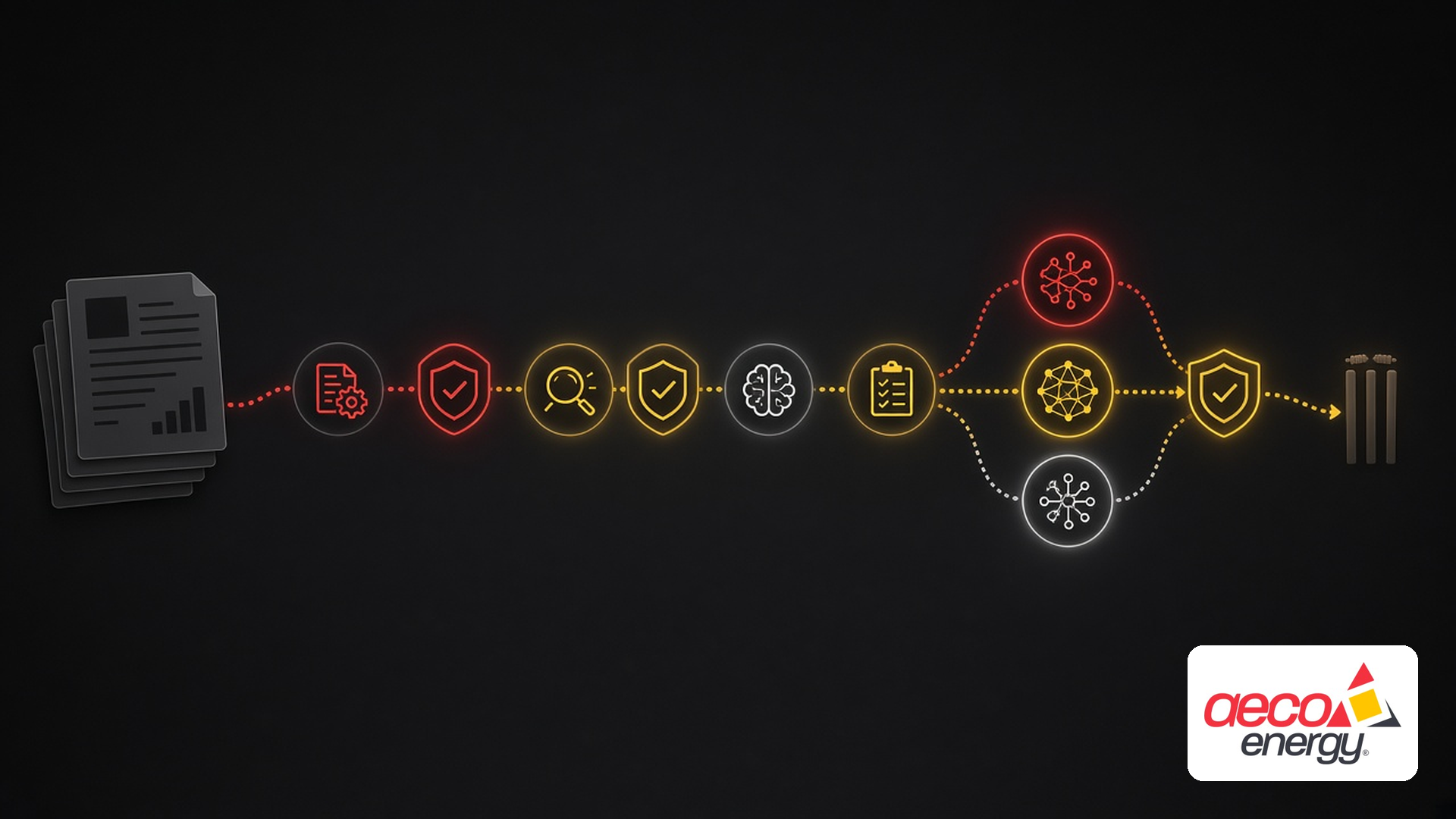
Cricket never solved umpiring by finding a perfect umpire.
It added a second look. Then a third umpire with replays. Then ball-tracking, and a microphone in the stumps for the faintest edge. None of those is perfect on its own, but together they get far more decisions right.
In our own work at AECO Energy, two ideas have done more for the quality of our AI output than anything else.
The first is a pipeline of independent checks. Rather than relying on one answer, each step’s output is checked in a different way before the next step uses it.
The second is breaking a big task into small steps, each of which produces an intermediate output you can see. That output is what the next check verifies. It’s also what lets you find exactly where something went wrong.
Why AI needs a second look.
Ask a large language model the same question twice and you may get two different answers. Usually both are fine. Now and then one is quietly wrong.
That’s simply how these models work. My original degree majored in statistics, and underneath the conversation an LLM is choosing each word from a spread of probabilities. It is non-deterministic: the same input won’t always give the same output. A spreadsheet formula or a small program is deterministic and gives the same answer every time.
Most of us start with AI as a chat window: one prompt, one answer. That’s a perfectly good place to start. It just isn’t the place to stop.
Big idea one: independent checks.
Here is the statistics, as a simple illustration. If one check misses 1 error in 10, and a second check also misses 1 in 10 but for different reasons, only about 1 in 100 gets past both. A third check takes that to about 1 in 1,000.
The key word is independent. Asking the same model the same question the same way tends to repeat the same mistake. So each check has to come at the work from a different angle: a different prompt, a different model, or a small program that doesn’t guess at all.
Big idea two: small steps with intermediate outputs.
You can’t check what you can’t see. Ask for a 50-page report in one go and the only thing you can check is the finished report, and by then an error could have come from anywhere.
Break the job into small steps, and have each one produce something tangible, such as a summary, a table of figures or a list of sources. Every intermediate output then becomes a checkpoint. It can be verified against the step before it, and if it fails, only that step needs to be redone.
An example: thousands of documents into one report.
Here is the kind of workflow we have found works. Imagine turning 3,000 customer documents into one comprehensive report.
(1) Summarise each document against a fixed template. That gives you 3,000 intermediate outputs, each one checkable.
(2) Check each summary against its original, asked a different way. For example, ask it to list every figure, name and date in the summary and quote where each one appears in the source. Anything it can’t find goes back for another pass.
(3) Check by code wherever the format allows it, such as totals that must add up, dates within the period and account numbers that must match. The AI can write the small program for you.
(4) Summarise the summaries, then check that every statement traces back to a verified summary.
(5) Build the report from a template, using only the verified material.
(6) Back-check the finished report by tracing its claims down through each layer of intermediate output to the original documents, using a fresh session or a different model.
Making it repeatable.
I built one of these harnesses myself, in Perl. It could just as easily have been Python, C, Rust, Go or any other language. The language matters far less than the design.
It uses models from 3 different vendors: Claude, Qwen and DeepSeek. The back checks always run on a different model from the one that did the work, because a different model brings different blind spots and that makes each check more independent.
When a step failed its check, the harness didn’t just try again the same way. It tried other combinations of models. Then deterministic checks, such as making sure the totals added up, decided whether the new output was right. The LLMs did the reading and writing, and plain code had the final word on the numbers.
Tools like Claude Skills let you package the steps, prompts, templates and checking programs so the job runs the same way every time, for anyone in the team. Each step gets the best tool for the job.
It takes a little longer than asking once. In our experience, these two ideas together are the biggest improvement in AI quality we have found, and they are well worth the extra time.
A gentle place to start.
Pick one workflow where you currently trust a single AI answer. Break it into small steps, and have each step produce an output you can see. Then add a check after each step that looks at the work differently, and use a program for the check wherever you can.
Don’t look for the perfect umpire. Build the review system.
Alan
This article was first published on LinkedIn.