Every office has one. The person everyone goes to when the spreadsheet breaks.
We all have the same copy of Excel. Yet in most teams a handful of people build the workbooks that everyone else uses, and the rest of us are very glad they do.
Nobody thinks that’s strange. We don’t send every person in the business on the advanced Excel course, or put the whole team through project management certification. We pick the people with the knack, and we invest in them.
Then AI arrives, and we seem to forget all of that.
We buy the licences, run the same session for everyone and expect the whole team to be writing great prompts and building their own AI skills by the end of the month. Too often we assume a uniform utopia of talent.
AI isn’t something special.
AI is a business skill, like spreadsheets, procedure writing or running a project. We already plan those skills. We know who is good at them, we train those people further and we let everyone else benefit from their work.
There is no reason to treat AI differently.
Writing a prompt is writing a procedure.
In my last article I wrote about breaking a task into small steps, each with an output you can check. That is exactly what a good business-as-usual procedure is: clear steps, a defined result for each one and a check before you move on.
Writing good prompts, and building reusable instructions such as Claude Skills, is the same ability. You have to know the job well, break it into steps, see where it can go wrong and write it down so someone else (or something else) can follow it without you in the room.
Some people do this naturally. Others find it hard, the same way many of us find it hard to write a procedure manual. That isn’t a failing. It’s a different strength.
For some staff, AI will mainly be a quicker way to look things up. I would argue that’s fine. Those same people are often our best on the customer call, in the negotiation or at the site visit – work that no prompt replaces.
Invest unfairly.
So here is my view. Not everyone should be trained to the same level. Everyone should get the basics. The extra training, the time and the attention should go to the people who have shown they can build.
That will sound unfair to some. In a sense it is. But equal training for unequal talent isn’t fairness, it’s waste. It gives you an uneven result anyway, just more slowly and at a higher cost.
Investing unevenly is not a judgement on anyone’s worth. We don’t think less of the person who never builds a pivot table. We simply don’t send them on the advanced course.
Upstream and downstream.
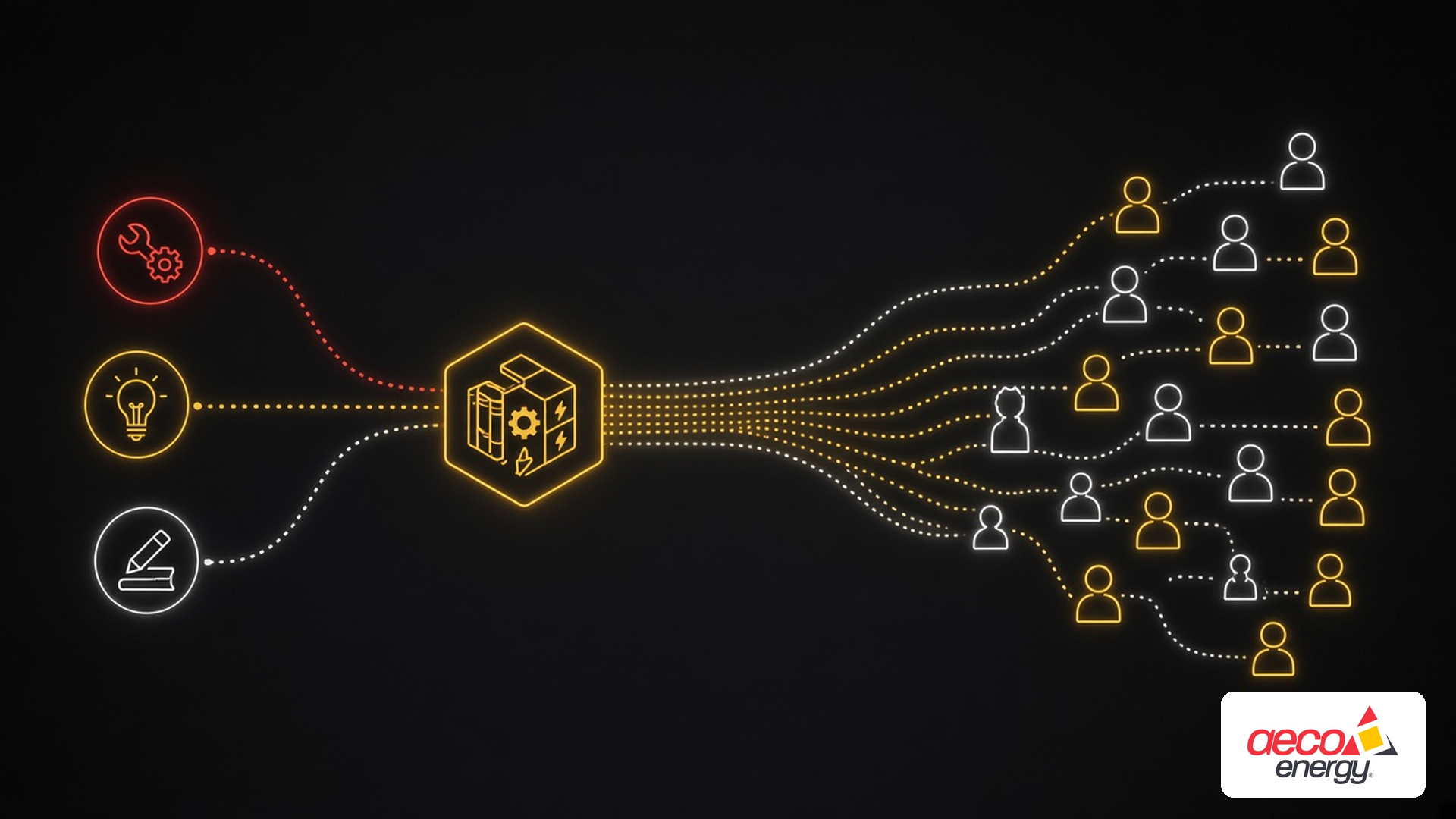
Think of it as a river. Upstream are the people with the talent and the creativity. Their job is to build a library of capability – skills, prompts, templates and automations – each one written once, checked and ready to use.
Downstream is everyone else. Their rollout shouldn’t be about building their own. It should be about using the library well: knowing what’s in it, picking the right tool for the job and checking what comes back.
That is where the output is magnified. As a simple illustration, in a team of 20 you might find 3 or 4 people upstream and 16 downstream. Those numbers are made up, but the shape will be familiar. If each of the 3 or 4 builds a skill that saves an hour a week, all 20 get the benefit, not just the builder.
So the extra training goes upstream. Downstream training is shorter, simpler and all about using the library.
In my opinion, skills and resource planning, and identifying the people with this talent, is one of the biggest accelerators of any AI rollout.
How to find the people.
(1) Look at who already writes the procedures. People whose instructions others can follow without phoning them are natural prompt writers.
(2) Look at the spreadsheet builders. A well-structured workbook takes the same clear, step-by-step thinking.
(3) Ask who colleagues go to. Every team knows who they ask when they’re stuck.
(4) Pair them up. Put a builder alongside someone who knows the job inside out. One brings the structure, the other brings the judgement.
(5) Train in tiers, not evenly. Real depth, time and support upstream. The basics and the library downstream.
(6) Build the library. Every skill goes into one shared place, so it’s built once and used many times.
A gentle place to start.
Before your next AI training session, take 30 minutes and list the people in your team who already write the procedures, build the spreadsheets or get asked for help. Those are probably your builders. Give them the extra training and a real problem to solve, and ask them to put what they build in the library.
Then train everyone else to use it.
Not everyone will build with AI. Everyone can benefit from what the builders make.
Alan
This article was first published on LinkedIn.